How Travelers Kept Records Before the Travel Diary
Travel records before the travel diary took different forms. Learn how letters, sketches, printed views, and keepsakes preserve distinct details of a journey.
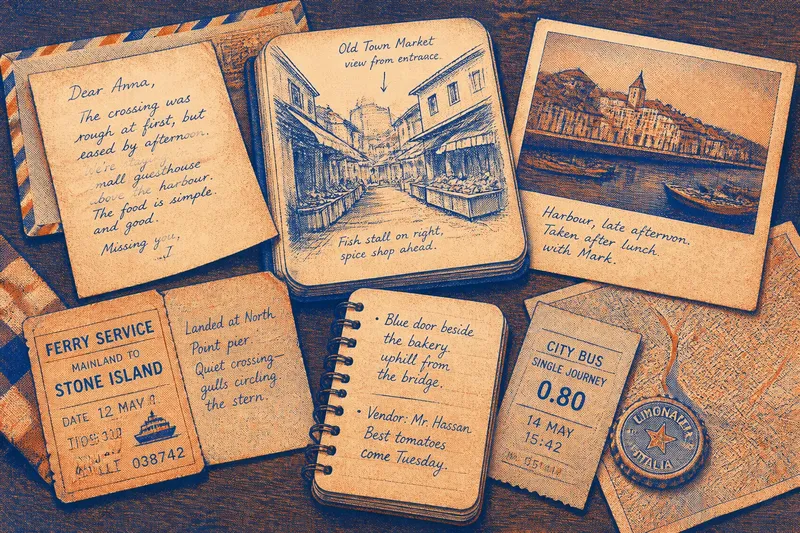
The common mistake is assuming every traveler once kept a private diary. Travel records before the travel diary took forms shaped by audience, materials, and opportunity: a letter sent home, a drawing made on the way, or an object kept as a reminder. None captured a whole journey, and that was not necessarily the point.
There is no single history that fits every traveler or period. The useful distinction is between kinds of records: each kept some details and let others fall away. That remains a practical way to choose a keepsake now.
Letters recorded what travelers chose to tell someone at home
A letter has a particular reader, even when that reader is imagined. Its writer may explain a difficult crossing, name a lodging, or describe a meal because those details answer questions someone at home might ask. The letter’s account is shaped by that relationship.
It can also preserve the circumstances of writing: a hurried message, a carefully composed account, or a note sent after a delay. But a letter is not a neutral transcript. Routine stretches may disappear, and the writer may smooth an untidy day into a story that is easier to tell.
For a keepsake made now, a short note addressed to someone specific can preserve the social side of a trip: who was missed, what needed explaining, or which detail seemed worth sharing. Its omissions are part of its character.
Sketches held shapes that prose could leave vague
A sketch can show how a stair turns, a roof meets a narrow lane, or a harbor edge bends around the water. Labels and arrows can add a place name or direction without asking the drawing to explain everything.
Drawing also requires a choice of viewpoint. A quick, rough page may preserve the angle of a doorway or the arrangement of stalls, but it may not say who opened the door or why the traveler stopped. Captions can supply that missing context.
Pair a sketch with the place, the direction of view, and one detail that would be hard to recover later. The drawing is like a map folded to one useful corner; the note explains why that corner mattered.
Printed views made travel easy to arrange and share
Printed views, postcards, and similar images let travelers bring home a recognizable scene without drawing it themselves. A caption might identify a landmark, while a handwritten message could join the ready-made image to a particular person or moment.
The image also reflects someone else’s choice of viewpoint. It may show a landmark clearly while omitting the detour, changing light, or less polished corner that made the visit memorable. An album’s sequence adds another interpretation: its order can turn a scattered trip into a neat set of highlights.
Keep the caption or message with the image. Without it, a familiar view may remain recognizable but lose its connection to the traveler’s route and purpose.
Small objects kept the material feel of a stop
Tickets, menus, labels, wrappers, and folded maps preserve details of what was handled or used. Their paper, printing, and marks can recall an ordinary stop in ways a general description may not.
An object needs context to do more than take up space. A ticket with a place and a short note can point back to a specific crossing; an unmarked ticket can become an attractive mystery. Keep an item if it identifies a place, records a useful detail, or marks an encounter you want to remember.
Imagine you have a ferry ticket from a crossing to a small island and want to remember more than the destination. You write the landing place on its back, then add that the crossing was quiet except for gulls circling the stern. Later, the ticket supplies its physical trace and the note restores one detail of the trip; neither has to serve as a complete account.
Compact notes caught the details between landmarks
A pocket notebook or loose note can hold a pronunciation, a turn in the road, a phrase overheard, or a shop name to find again. These fragments work best when they include enough context to make sense later.
“Blue door beside the bakery, uphill from the bridge” is more useful than an unexplained arrow. Add where you were and why the detail mattered. A few clear words are kinder to your future self than a page of private shorthand.
Short notes suit travel’s shifting rhythm: they can preserve a pause before a turn or a conversation that changed the plan without requiring a settled evening or a polished account.
Choose a record that matches the detail you want to keep
Modern records may combine written notes, photographs, voice memos, and saved maps. The formats do different work: a photograph can retain color and arrangement, a voice memo can keep cadence, and a note can explain why either one mattered. A folder of files still needs captions if the details are to remain recognizable.
Use these checks to choose what to keep and how to label it:
- Observation: The important memory is a conversation. If you can identify the person’s role and the subject, keep a brief written note; otherwise, add those details before saving a voice memo or message.
- Observation: The memory depends on how a street or room was arranged. If a sketch can show the relevant shapes, draw and label them; otherwise, take a photograph and add the viewpoint or feature you want to remember.
- Observation: A paper item has a place name or date printed on it. If that information identifies the stop, keep the item with a short note; otherwise, write its location and context on a separate slip or let it go.
- Observation: A photograph has only a vague filename such as “Tuesday.” If you can recall the stop, rename it or add a caption; otherwise, record the route or companion while the context is still clear.
- Observation: A pocket note contains initials or an unexplained arrow. If you can still identify the person or direction, expand the shorthand; otherwise, mark what remains uncertain rather than treating a guess as fact.
- Observation: Two keepsakes preserve the same detail. If one has clearer context or adds a distinct sensory or personal clue, keep that one; otherwise, retain the item that is easier to identify and release the duplicate.
Say you want to remember a visit to a market, but the details most likely to blur are its layout and a brief exchange with a vendor. You make a quick sketch of the stalls and mark the entrance, then write the market’s name and the vendor’s suggestion beside it. You also take a photograph, but its filename says only “Tuesday.” Because the sketch and note already identify the place and preserve the exchange, you rename the photograph with the market’s name and keep it only if its colors add something the sketch cannot. The result is a small set of records with distinct jobs, rather than several unlabelled versions of the same stop.
Which travel record fits a particular memory?
Are letters better than travel diaries?
Letters preserve what a traveler chose to tell someone specific, including explanations and reassurance. A diary may hold private thoughts more freely, but neither form is inherently more complete.
What can a sketch preserve that a photograph may not?
A sketch makes the traveler select and simplify a view, which can clarify how its shapes relate. A photograph retains more visual detail, while a drawing can make one chosen structure easier to notice.
How can you keep travel keepsakes from becoming clutter?
Give each object a place and a reason for keeping it, then compare it with the other records from that stop. Keep it if it adds a distinct detail; otherwise, let the better-labeled record carry the memory.
Can a short note preserve an encounter?
Yes, if it records where the encounter happened, what the person did or said, and the detail that stayed with you. It need not reproduce the whole conversation to preserve its character.
Keep the format that memory is most likely to lose
The useful question is not which record makes the most impressive archive. It is which part of the journey you are likely to lose first. A letter can keep the shape of an exchange, a sketch the arrangement of a place, and a pocket note the detail that never became a landmark.
Travel records before the travel diary were varied because people had different audiences, materials, and reasons to remember. The same choice is available now: select a form suited to the detail, then add enough context for your future self to recognize it. A labeled drawer is less romantic than a mystery box, and considerably more helpful.