A First Morning in an Unfamiliar Market
A first morning in an unfamiliar market feels easier when you read its layout and routines before buying, so your next choice follows the place.
The common mistake in an unfamiliar market is to treat the entrance as a starting gun: step inside, buy the first appealing thing, then try to make sense of the rest while carrying it. A first morning in an unfamiliar market goes more smoothly if you spend a little time reading the place before choosing what to buy or where to go next. The cost of rushing is not usually a ruined outing; it is a sequence of small, avoidable decisions made without knowing what the market is doing.
Let the entrance show you how the market works
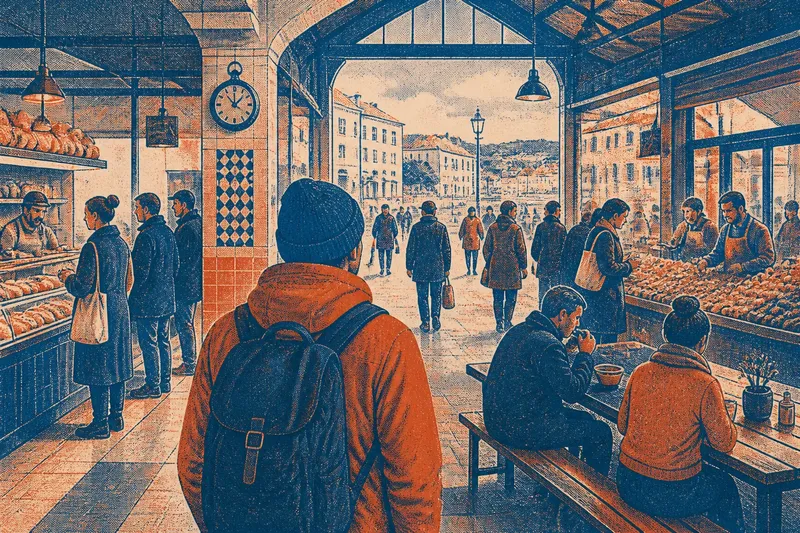
Say you arrive in an invented coastal town on a cloudy morning and find a covered market opening onto a narrow square. You have an hour before meeting a travel companion. At the entrance, one aisle seems to lead directly to a bakery, another bends out of view, and a row of tables stands under the roof. You are hungry, but instead of joining the first queue, you pause just inside the doorway.
That pause is not a sightseeing performance. It gives your eyes time to adjust to the light and your ears time to separate the market’s general hum from its useful cues. Look for where people enter and leave, whether the main aisle carries foot traffic in both directions, and where customers stop without blocking anyone. A market’s layout is often easier to understand from its edges than from the middle of a busy passage.
Notice the difference between a route and a destination. A broad aisle may be the market’s main thoroughfare, while a short side passage leads to a small counter or a courtyard. Stalls facing one another can form a natural corridor; a cluster of tables may mark a place where visitors pause to eat. You do not need to name every section. A few landmarks—a tiled pillar, a clock, a doorway to the square—are enough to help you keep your bearings.
Think of the first pass as looking at a room before choosing a chair. The furniture has not changed, but you can see where people move and where they settle. In the market, that simple reading helps you avoid standing in a delivery path or mistaking a working counter for a place to linger.
Read the traffic without turning people into exhibits
Movement tells you more than a stall’s display alone. Watch, briefly and discreetly, where customers slow down, whether they point or ask questions, and how vendors signal that they are ready to serve. A queue may form at one counter and not another; someone may collect a wrapped parcel and leave without looking at the other stalls. Those patterns suggest what the market is for its regulars, though they do not oblige you to imitate every routine.
Keep the observation practical and respectful. You are trying to understand how to move, not to catalog strangers. Stand to one side rather than stopping in the center of an aisle. If a vendor is serving someone, wait for a natural pause before approaching. If people are carrying trays or crates through a passage, leave them room. A market is a place of work as well as a place to browse, and its rhythm belongs to the people who use it every day.
Notice what happens at the edges of the busiest moments. A worker may refill a display, sweep a patch of floor, or carry a basket from a back room. A customer may greet a vendor before ordering, then move aside to let the next person step up. These small routines can tell you whether a counter is suited to a quick purchase, a conversation, or neither. They also make the place legible without requiring you to ask for a tour.
Sound can help, but it is not a translation service. A bell might mark a doorway, a clatter might come from dishes rather than a stall, and overlapping voices may simply be the room’s ordinary level of conversation. Listen for changes: the brief quiet when a customer finishes speaking, the call that draws attention to a newly opened counter, or the steady rustle of people moving between aisles. Use these cues to orient yourself, then check what you see before deciding what they mean.
Make a first loop before making a purchase
In the invented coastal market, you take a slow loop around the perimeter before crossing the center. The bakery queue reaches only a few people, but a side counter has a small gap in front of it. At the far end, a doorway opens onto the square. You mark those three points in your mind and pass the bakery without buying anything yet.
That first loop is useful because it separates noticing from choosing. On a second pass, you can return to something that genuinely interests you instead of buying it because it appeared first. You might discover that the bakery sells a local morning pastry, that a fruit stall has the kind you recognize, or that the counter you had mistaken for a café is actually a place where customers collect prepared orders. The point is not to delay every decision. It is to give yourself enough context to make one that fits.
Before buying, look at how the exchange works. Are items displayed with names or prices? Do customers point, ask for a portion, or choose from a tray? Is there a clear place to wait? If the routine is unclear, a short, courteous question is usually more useful than guessing. Keep the question narrow: ask what an item is, whether the counter is open, or where to queue. If you cannot communicate comfortably, a gesture toward the item and a polite greeting may be enough to begin.
Pay attention to the practical side of carrying what you buy. A hot drink or loose fruit changes how freely you can explore; a wrapped item may be easier to take along. This is not a reason to avoid anything appealing. It is a reason to consider whether you want to eat now, sit nearby, or keep walking with your hands free. A small purchase can shape the rest of the morning more than its size suggests.
In this invented situation, you return to the bakery, order one pastry, and step away from the counter before opening the paper wrapping. The observable result is modest: you know where the exit is, you have seen how the aisles connect, and you can eat without blocking the queue. You have not solved the whole market. You have made the next choice easier.
Choose a place to pause before the market chooses for you
Markets often contain several kinds of stopping place: a shared table, a ledge near a window, a bench in the adjoining square, or no seating at all. Look for how each is used before settling in. A table may be reserved for customers eating from nearby stalls; a ledge may be part of a vendor’s working area; a bench outside may be the least intrusive place to unpack a snack. If the arrangement is unclear, ask rather than assuming that an empty seat is available.
A pause gives you a chance to notice what you missed while moving. From a seat or a quiet edge, you may see that the main aisle clears when a delivery is finished, or that one entrance is more convenient for leaving. You may also realize that the market is becoming crowded, or that its quieter corners are more interesting to you than the busiest counters. Either observation can guide your next move without turning the visit into a race to see everything.
Keep your pause flexible. If you are carrying food, finish it where that is welcome and dispose of packaging appropriately. If the market is busy, do not occupy a place longer than you need while others are waiting. A short break should leave you better oriented, not installed as a new piece of furniture.
Small questions help when the routine is unclear
Should I buy something as soon as I arrive?
No. A brief look around can show you where the queues form and whether the item you noticed is easy to carry. If you already know what you want and the counter is clearly ready to serve, buying immediately is fine; the first loop is an option, not a ritual.
How can I tell where to queue?
Look for the line of customers, a marked waiting area, or the direction in which people approach and leave. If more than one arrangement seems plausible, ask the vendor or wait to see how the next customer proceeds without blocking the counter.
What if I do not understand the language?
Use a friendly greeting, point clearly, and keep your question simple. A label, menu, or visible display can help, but avoid handling goods unless customers are doing so or the vendor invites you to choose them.
How long should I spend looking around?
Long enough to understand the main route and find one or two places you may want to revisit. The useful measure is not time but whether you can make your next choice without guessing where to stand, sit, or leave.
Carry the market’s rhythm into your next decision
As the invented morning unfolds, the bakery line begins to lengthen and a side aisle grows quieter. You have already eaten, so you take the side aisle rather than joining another queue. It leads to a small produce stall where the vendor is arranging greens. You ask what a bundle is, learn its name, and decide not to buy it because you have no good way to carry it. Then you leave through the doorway you noticed on your first pass and meet your companion in the square.
That ending is useful because it leaves room for a decision not to buy. A market visit does not need to produce a bag of food to count as a visit. You can leave with a clearer sense of the place, a snack, a new word, or simply an idea of where you might return. The most satisfying purchase is sometimes the one you make after you know what you are choosing; sometimes the better choice is to keep your hands free.
For your own first morning in an unfamiliar market, start with the entrance, trace one unhurried loop, and notice how people move before you join a line. Keep an eye on the routes that remain open and the spots where customers can pause. Then choose one small action: ask a question, buy something easy to carry, sit where it is welcome, or continue on. A market becomes easier to enter when you let its ordinary routines set the pace.